
PART 2 — THE NAME MISSING FROM THE LIST
For several seconds, my father did nothing.
Through the glass doors of the auditorium lobby, Lieutenant General Harlan Vale stood frozen with one hand still resting on the installation commander’s shoulder.
The smile left his face.
Not dramatically. My father had spent forty years learning how to keep emotion from reaching the surface. It simply disappeared, as though someone had quietly switched off a light behind his eyes.
The installation commander followed his gaze.
Major General Elias Mercer was a compact man in his late fifties with the kind of calm expression that usually meant he had already noticed everything in the room before anyone else had noticed him.
His eyebrows lifted when he saw me.
Then, unexpectedly, he smiled.
My father did not.
I entered the lobby.
A few officers near the doors turned. One recognized me. Then another.
Small changes passed through the room—the straightening of shoulders, a pause in conversation, a glance at my insignia.
I had never liked that effect.
Rank created distance before a person had spoken a word.
Mercer crossed the lobby toward me.
“Sable.”
“General.”
He offered his hand.
“I was beginning to wonder whether you’d changed your mind.”
That made my father look sharply at him.
“I said I would come.”
“You did.”
Mercer’s smile became faintly amused. “Although your father apparently neglected to tell anyone that.”
My father’s jaw tightened.
“Harlan?” Mercer said.
My father finally walked toward us.
Up close, he looked older than he had in the photographs my mother occasionally sent.
Not weak.
Harlan Vale would probably object to weakness on principle until the day he died.
But there were new lines beside his eyes. His hair, once iron gray, had become almost completely silver.
His gaze moved across my uniform and stopped briefly at the star on my shoulder.
“You made general.”
It was an extraordinary sentence.
Not congratulations.
Not when?
Just an observation, almost carefully neutral.
“Seven months ago.”
He blinked.
“I hadn’t heard.”
“I wasn’t aware you were waiting for an announcement.”
Something flickered across Mercer’s face.
My father looked away.
The words had come out more sharply than I intended.
Twenty years of practiced restraint, and apparently all it took to crack it was six words from my father in a polished lobby.
He cleared his throat.
“You could have called.”
I almost laughed.
“So could you.”
Mercer glanced toward the auditorium doors.
“If the two of you intend to settle twenty years of family communication before the ceremony, I may need to delay retirement another day.”
That was Mercer.
Never joking enough to be called humorous, but never entirely serious either.
My father exhaled.
“Sable, I didn’t know you were coming.”
“That became clear at the gate.”
His head turned.
“What?”
“My name wasn’t on the family access list.”
For the first time, genuine surprise broke through his composure.
“That isn’t possible.”
“It was remarkably possible.”
“I gave the staff—”
He stopped.
Mercer was watching him.
My father looked toward an aide standing near the reception table.
“Colonel Park.”
The colonel approached immediately.
“Yes, sir?”
“The guest list. Was Brigadier General Vale included?”
Park looked uncomfortable.
“General Vale was processed separately, sir.”
“Separately?”
“Yes, sir. Headquarters sent instructions Tuesday. General Mercer requested she be registered as an official distinguished guest rather than under the family manifest.”
My father looked at Mercer.
Mercer gave a small nod.
“She was always cleared to attend.”
I stared at him.
“The corporal at the gate couldn’t find me.”
“Because you were looking at the family list,” Mercer said. “Your official credential was on the command roster.”
He glanced at my uniform.
“Which he apparently discovered.”
So the omission had not prevented me from entering.
That did not make the omission meaningless.
My father understood that too.
His face had gone quiet.
“You weren’t on the family list?”
“No.”
He looked toward my mother.
She had entered from the auditorium and was standing several yards away beside Penn and Liora.
My mother finally met my eyes.
“Sable.”
“Mother.”
Marion Vale had always possessed the ability to make a single word feel like an entire conversation.
She crossed the lobby carefully, holding her clutch in both hands.
“You look well.”
“You too.”
Penn came behind her.
Up close, my younger brother looked almost exactly like our father had at forty—same square jaw, same controlled posture, same habit of inspecting a room while pretending not to.
Only his eyes were softer.
He gave me a guarded smile.
“Congratulations.”
“For what?”
“The star.”
“You noticed.”
“Hard not to.”
Liora touched his arm.
“Penn.”
“What?”
Her look said enough.
He shifted.
“I meant it as congratulations.”
“I know.”
That seemed to surprise both of us.
My mother stepped closer.
“We should go inside. They’re seating the family.”
She said it naturally.
The family.
Then her expression changed.
Just slightly.
Because she realized what she had said.
I looked toward the auditorium.
“Apparently that’s where the confusion begins.”
My father’s shoulders stiffened.
“Sable.”
Mercer interrupted before another sentence could turn into something we could not retrieve.
“Harlan, you have twelve minutes before the ceremony begins.”
My father’s eyes remained on me.
“Afterward.”
It sounded like an order.
I almost told him no on reflex.
Instead I said, “If you want.”
His expression changed again.
That answer had not been what he expected.
Neither was it what I expected.
He nodded.
“If you want.”
It was the first time I could remember my father correcting an order into an invitation.
My assigned seat was in the second row.
Not with my family.
That detail should have irritated me.
Instead, strangely, it helped.
I sat beside Lieutenant General Naomi Kessler, whom I had known for twelve years, and Ambassador Rafi Hamdan, who had once spent three sleepless nights arguing with me over whether a border crossing would remain open.
Kessler leaned toward me.
“Your father doesn’t know?”
“Apparently not.”
“About the promotion?”
“Among other things.”
Her eyes moved toward the front row, where my mother sat between Penn and my father.
“That explains his face.”
“What face?”
“The one generals wear when they discover they have somehow missed an entire war occurring inside their own house.”
I almost smiled.
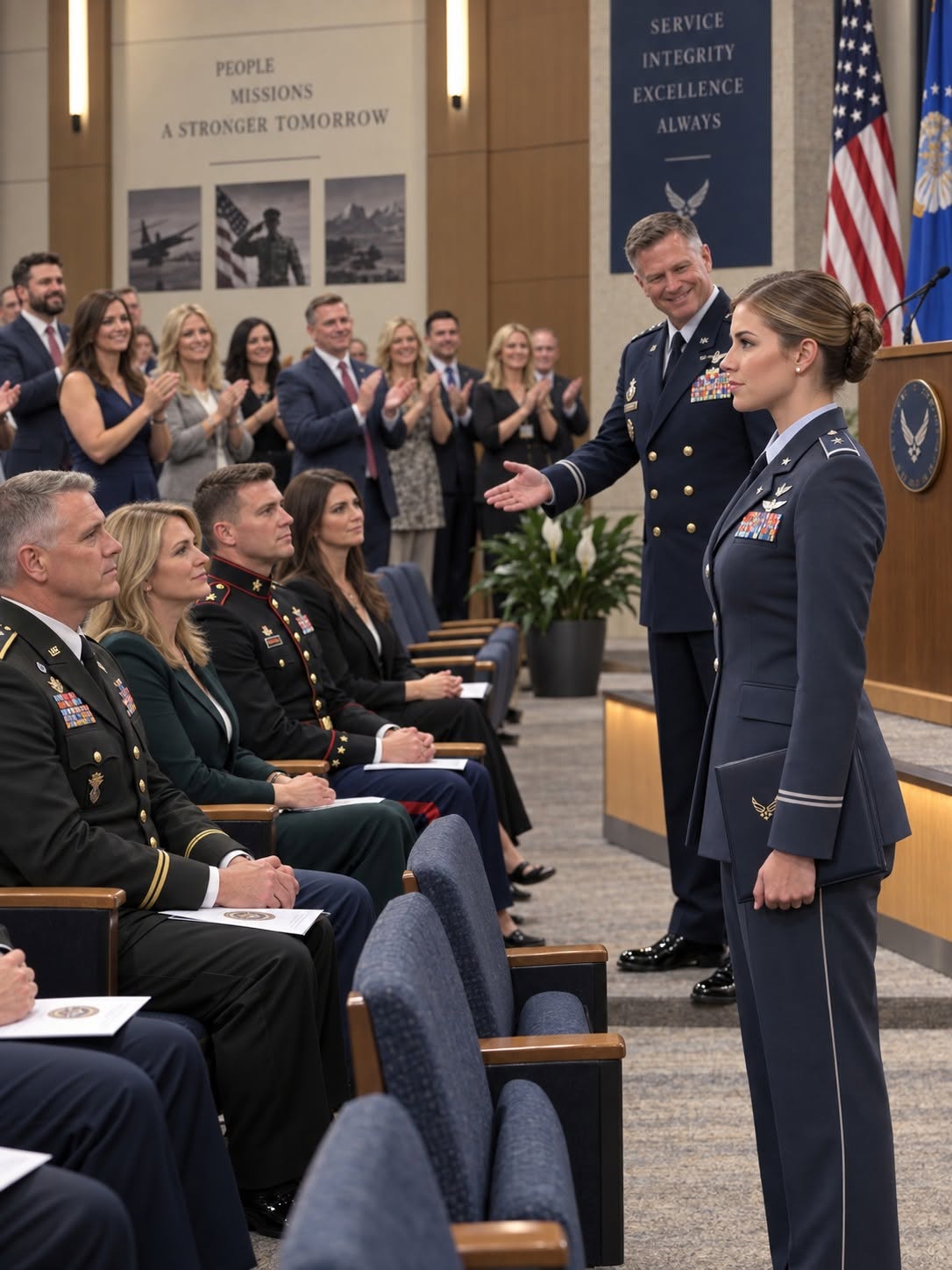
The ceremony began.
There were flags, official remarks, a chaplain’s invocation, and the familiar cadence of military language polished by generations of repetition.
Service.
Duty.
Sacrifice.
Legacy.
My father sat straight-backed beneath the stage lights.
I watched him while other people described the man I knew only in fragments.
They spoke about the young officer who had once driven overnight through a snowstorm because a soldier’s family had been stranded.
The colonel who remembered the names of mechanics.
The commander who had refused to accept a promotion recommendation until three younger officers received theirs first.
I knew none of those stories.
That unsettled me.
For years, I had reduced my father to the role he played inside our house: demanding, formal, impatient with ambiguity.
Yet everyone here seemed to possess a different piece of him.
Perhaps that was what families did.
We collected incomplete versions of one another and eventually mistook them for whole people.
Mercer approached the podium.
“Harlan Vale has served this country for forty-one years, three months, and six days.”
A soft ripple of laughter moved through the room.
“Harlan would insist the six days matter.”
My father smiled.
“They do,” he called.
More laughter.
Mercer continued.
“There is a temptation at retirement ceremonies to speak only of what a leader accomplished. But accomplishments don’t happen alone. Careers like Harlan’s are built beside families, colleagues, mentors, friends—and sometimes children who quietly choose difficult roads of their own.”
My father’s smile faded.
I felt Kessler turn slightly toward me.
Mercer looked into the audience.
“Today we have several distinguished guests, but one deserves particular recognition.”
I knew what was coming.
My father did not.
Mercer smiled.
“Brigadier General Sable Rowan Vale. Our highest honor.”
The room rose.
Not every person knew me personally, but enough did.
Some applause was formal.
Some wasn’t.
Ambassador Hamdan clapped like he intended to damage his hands.
Kessler stood beside me, grinning.
I rose because remaining seated would have been stranger.
Across the aisle, Penn stared.
Liora’s mouth had opened slightly.
My mother’s hand covered her lips.
And my father—
Every trace of pride vanished from his face.
At least, that was how it looked from where I stood.
His expression collapsed into something I had never seen before.
Not anger.
Not resentment.
Something closer to shock.
Then shame.
He looked down.
The applause continued.
I wished it would stop.
Mercer waited until everyone sat.
“General Vale recently completed an assignment whose details are not relevant to today’s gathering. What is relevant is that officers and service members are home with their families because of decisions she and her team made.”
He turned toward my father.
“Harlan, forgive me for embarrassing your daughter.”
That drew light laughter.
I managed a smile.
“But I thought you should know.”
My father looked directly at me.
For the first time all morning, I saw no general sitting in the front row.
Only my father.
And he looked devastated.
After the ceremony, people gathered beneath a white reception canopy overlooking the parade field.
April sunlight broke through the clouds.
I had survived briefings before cabinet officials with less discomfort than I felt holding a cup of coffee while strangers told me how proud my father must be.
“He certainly raised two remarkable officers.”
“You must be an extraordinary military family.”
“Your father talked constantly about legacy.”
Each sentence landed strangely.
Finally, I escaped toward the edge of the field.
“You always did that.”
Penn’s voice came behind me.
I turned.
“Did what?”
“Leave crowded rooms without anybody seeing you.”
“Occupational skill.”
He shoved his hands into his trouser pockets.
For a moment we stood silently.
Then he said, “I didn’t know.”
“About the promotion?”
“Any of it.”
“That makes two of you.”
Penn stared toward the reception tent.
“You think Dad deliberately left you off the list.”
“I think my name wasn’t there.”
“That’s not what I said.”
I studied him.
Penn had been thirteen when I left for university. By the time he commissioned, I was already moving through assignments I couldn’t explain.
I remembered him as a boy standing in my doorway asking whether I would teach him to drive before I deployed.
I had said I would.
I hadn’t.
“What do you think happened?” I asked.
He rubbed his thumb along the side of his hand.
“I put the family list together.”
That surprised me.
“You?”
“Dad gave me the names.”
“And mine wasn’t among them.”
Penn swallowed.
“No.”
There it was.
Clean and simple.
I nodded once.
“Thank you for telling me.”
“Sable—”
“It’s fine.”
“No, it isn’t.”
I looked at him.
He sounded almost angry.
Not with me.
“With Dad?” I asked.
“With all of us.”
He lowered his voice.
“We stopped asking questions because it was easier.”
That sentence followed me through the rest of the afternoon.
My father found me in his office shortly before sunset.
Most of the photographs had already been removed from the walls.
Cardboard boxes sat on the floor.
A forty-year career reduced to plaques, books, challenge coins, photographs, and a coffee mug with a cracked handle.
He closed the door.
“I owe you an explanation.”
“I thought you might.”
He moved behind his desk but did not sit.
“I didn’t put you on the family list.”
“I know.”
“Penn told you.”
“Yes.”
He nodded.
“I wasn’t certain you’d come.”
“You could have invited me.”
“I did.”
I stared at him.
“No, you didn’t.”
My father opened a drawer.
From inside, he removed a cream-colored envelope.
My name was handwritten across the front.
Brigadier General Sable Rowan Vale.
Below it was an address I had not used in three years.
The envelope was stamped.
Returned to sender.
I picked it up.
“When did you mail this?”
“January.”
I turned it over.
A postal label marked it undeliverable.
“You had my official contact information.”
“I didn’t know whether using it for something personal was appropriate.”
“You could have called.”
“Yes.”
“Or emailed.”
“Yes.”
“Or asked Mother.”
His eyes lowered.
“Yes.”
I put the envelope on the desk.
“So why didn’t you?”
For a long moment, my father said nothing.
Outside, a bugle sounded across the installation.
The notes drifted faintly through the window.
“At your promotion to colonel,” he said, “I told people about you.”
I remembered.
Eight years earlier.
A hotel ballroom.
My father shaking hands with people he did not know.
Introducing me as if my career were another medal pinned to his chest.
I had been exhausted from an assignment and furious at being discussed publicly.
“I asked you to stop.”
“You told me never to use your career to make myself important.”
I winced.
I remembered those words too.
“I was angry.”
“I know.”
“I didn’t tell you to erase me.”
“No.”
He walked toward the window.
“But afterward, one of your senior officers spoke to me.”
I frowned.
“Who?”
“Colonel Mara Quinn.”
My former mentor.
Now retired.
“She told me your work was becoming more sensitive. She said the safest way I could help was by letting you decide what the family knew and what I said publicly.”
“That sounds like Mara.”
“I decided silence was respect.”
I stared at him.
“For twenty years?”
“No.”
He turned around.
“At first, yes.”
His face looked tired.
“Then the longer you stayed away, the more convinced I became that silence was what you wanted.”
“I stayed away because every time I came home, nobody asked me anything.”
“We thought you couldn’t answer.”
“You could have asked whether I liked my apartment. Whether I was tired. Whether I wanted pie.”
His expression tightened.
“You’re right.”
Those two words startled me more than any defense could have.
My father was not famous for surrendering ground.
He sat in the chair opposite me.
“I mistook respecting your boundaries for having no responsibility to cross the distance between us.”
Something in my chest shifted.
Not forgiveness.
Not yet.
But the first movement of something frozen.
I glanced around the office.
There were empty rectangles on the wall where photographs had hung.
Only one remained.
Penn at his commissioning.
I looked away.
My father noticed.
“There were others.”
I almost smiled bitterly.
“Were there?”
He stood.
Without explaining, he crossed to one of the packed cardboard boxes and lifted the top flap.
Then he stopped.
Whatever was inside changed his face.
He reached down and handed me a framed photograph.
I recognized it immediately.
My graduation from officer training.
I was twenty-two.
Sunburned.
Grinning.
My father stood beside me in uniform, one hand awkwardly resting on my shoulder.
Behind that photograph was another.
My first promotion.
Another.
A newspaper clipping from an exercise in Germany where my name appeared in a caption.
Another.
A photograph of me and Mara Quinn outside a headquarters building.
My throat tightened.
The entire box was mine.
Articles.
Printed promotion announcements.
Programs.
Photographs.
Even a copy of an intelligence journal containing an essay I had published under my full name years earlier.
“You kept these?”
“All of them.”
“Then why weren’t they on the wall?”
“They were.”
“When?”
“For years.”
He looked toward the empty rectangles.
“I took them down Monday.”
“Why?”
He hesitated.
And suddenly I understood there was still something he wasn’t telling me.
“Harlan?”
Neither of us noticed my mother standing in the doorway until she spoke.
“He took them down because of me.”
I turned.
My mother’s eyes were red, but her voice was steady.
My father rose slowly.
“Marion.”
“No,” she said. “She’s spent enough years knowing half the truth.”
She looked at me.
“Sable, your father didn’t stop talking about you because he wasn’t proud.”
Her hand tightened around the edge of the door.
“He stopped because three months ago I asked him to.”
I stared at her.
“Why?”
My mother took a breath.
“Because I found something in this office.”
The room seemed suddenly very quiet.
“What?”
She looked at my father.
He did not stop her.
Then she looked back at me.
“A letter you wrote him fourteen years ago.”
My stomach tightened.
“I don’t remember writing a letter.”
“You would,” she said softly, “if you’d known he ever received it.”
And from the expression on my father’s face, I realized whatever that letter contained had been sitting between us for fourteen years.
-END OF PART 2, –PRESS NEX PART IN BOTTOM OF PAGE TO READ NEXT PART
